[30]
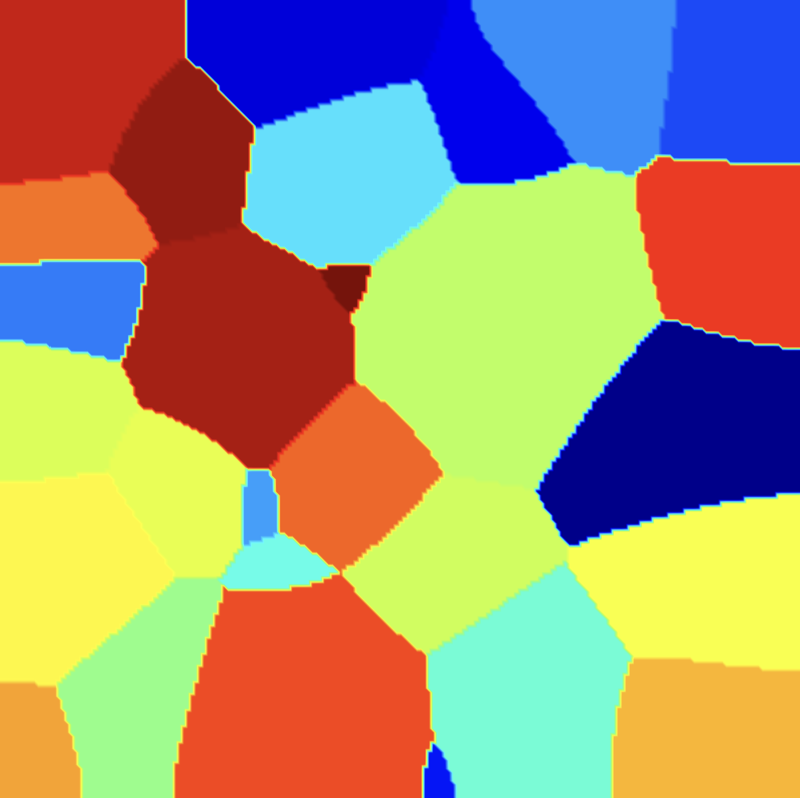
Threshold dynamics for subdiffusive grain growth
M. Fritz
[29]
High-order conforming finite elements for the Cahn–Hilliard equation: Relative-energy stability and energy defects
A. Brunk, M. Fritz
[28]
Review of thermodynamic structures and structure-preserving discretisations of Cahn–Hilliard-type models
A. Brunk, M. ten Eikelder, M. Fritz, D. Höhn, D. Trautwein
[27]
Unifying local and nonlocal corrosion frameworks: A convergent nonlocal extension of the KKS phase-field model
C. Cyron, M. Fritz, A. Hermann, T. Köppl, A. Shojaei, S. Silling
[26]
A four-field auxiliary reformulation of a Cahn–Hilliard time step: Analysis and conforming finite element discretization
M. Fritz
[25]
A fractional de Rham complex for coframe-attached Maxwell equations
M. Fritz
[24]
Rothe time discretization and weak solutions for a cutoff Westervelt system
M. Fritz
[23]
A time-fractional Fisher–KPP equation for tumor growth: Analysis and numerical simulation
M. Fritz, N. Kavallaris
[22]
On the well-posedness of a nonlocal kinetic model for dilute polymers with anomalous diffusion
M. Fritz, E. Süli, B. Wohlmuth
[21]
Stabilization to trajectories of nonisothermal Cahn–Hilliard equations
B. Azmi, M. Fritz, S. Rodrigues
[20]
Analysis and discretization of the Ohta–Kawasaki equation with forcing and degenerate mobility
A. Brunk, M. Fritz
[19]
Analysis and structure-preserving approximation of a Cahn–Hilliard–Forchheimer system with solution-dependent mass and volume source
A. Brunk, M. Fritz
[18]
Structure-preserving approximation of the Cahn–Hilliard–Biot system
A. Brunk, M. Fritz
[17]
Well-posedness, long-time behavior, and discretization of some models of nonlinear acoustics in velocity-enthalpy formulation
H. Egger, M. Fritz
[16]
On feedback stabilisation for the Cahn–Hilliard equation and its numerical approximation
H. Egger, M. Fritz, K. Kunisch, S. Rodrigues
[15]
Analysis and computations of a stochastic Cahn–Hilliard model for tumor growth with chemotaxis and variable mobility
M. Fritz, L. Scarpa
[14]
On the well-posedness of the Cahn–Hilliard–Biot model and its applications to tumor growth
M. Fritz
[13]
Well-posedness and simulation of weak solutions to the time-fractional Fokker–Planck equation with general forcing
M. Fritz
[12]
Analysis of a dilute polymer model with a time-fractional derivative
M. Fritz, E. Süli, B. Wohlmuth
[11]
Tumor evolution models of phase-field type with nonlocal effects and angiogenesis
M. Fritz
[10]
Equivalence between a time-fractional and an integer-order gradient flow: The memory effect reflected in the energy
M. Fritz, U. Khristenko, B. Wohlmuth
[9]
A phase-field model for non-small cell lung cancer under the effects of immunotherapy
A. Wagner, P. Schlicke, M. Fritz, C. Kuttler, J. T. Oden, C. Schumann, B. Wohlmuth
[8]
A 1D–0D–3D coupled model for simulating blood flow and transport processes in breast tissue
M. Fritz, T. Köppl, J. T. Oden, A. Wagner, B. Wohlmuth, C. Wu
[7]
Time-fractional Cahn–Hilliard equation: Well-posedness, degeneracy, and numerical solutions
M. Fritz, M. L. Rajendran, B. Wohlmuth
[6]
Modeling and simulation of vascular tumors embedded in evolving capillary networks
M. Fritz, P. K. Jha, T. Köppl, J. T. Oden, A. Wagner, B. Wohlmuth
[5]
Analysis of a new multispecies tumor growth model coupling 3D phase fields with a 1D vascular network
M. Fritz, P. K. Jha, T. Köppl, J. T. Oden, B. Wohlmuth
[4]
On a subdiffusive tumour growth model with fractional time derivative
M. Fritz, C. Kuttler, M. L. Rajendran, B. Wohlmuth, L. Scarabosio
[3]
Local and nonlocal phase-field models of tumor growth and invasion due to ECM degradation
M. Fritz, E. A. B. F. Lima, V. Nikolić, J. T. Oden, B. Wohlmuth
[2]
On the unsteady Darcy–Forchheimer–Brinkman equation in local and nonlocal tumor growth models
M. Fritz, E. A. B. F. Lima, J. T. Oden, B. Wohlmuth
[1]
Well-posedness and numerical treatment of the Blackstock equation in nonlinear acoustics
M. Fritz, V. Nikolić, B. Wohlmuth